
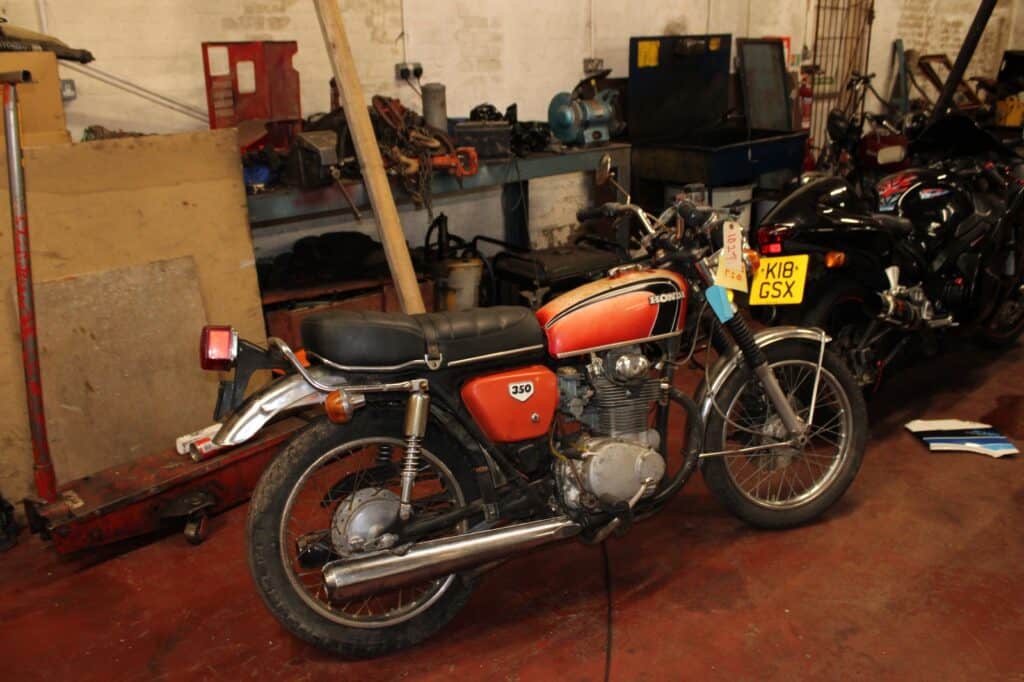
Ask any gathering of classic motorcycle enthusiasts for their views on the two-stroke versus four-stroke debate and you will generate more heat than light — because ultimately it is not a debate with a correct answer. The two approaches to internal combustion produce machines of entirely different character, and the choice between them is one of personal preference as much as mechanical reasoning. At South Wales Classic Motorbikes, we appreciate both, and we want to explain what each offers to the classic enthusiast.
The Four-Stroke Case
Four-stroke engines produce power on every other revolution of the crankshaft — intake, compression, combustion, exhaust — with a power delivery that is smooth, progressive, and immediately accessible from low revs. They are generally more fuel-efficient, produce fewer unburned hydrocarbon emissions, and require less frequent attention to consumables than two-stroke equivalents. The four-stroke classics of the 1960s and 70s — British twins, Japanese fours, Italian V-twins — represent the mainstream of the classic market and offer the widest range of options at every level of the market.
The Two-Stroke Case
A two-stroke engine produces a power stroke on every revolution — which means, all else being equal, it produces more power per unit of displacement than a four-stroke. The classic two-stroke road bikes of the 1970s — Yamaha’s RD series, Kawasaki’s triples, Suzuki’s GT series — were extraordinarily fast for their engine sizes, and they produced a power delivery that is unlike anything a four-stroke can replicate: relatively flat below a certain point in the rev range, then a sudden, electrifying surge as the powerband arrives.
Maintenance Differences
Two-stroke engines mix oil with the fuel for lubrication — either through a separate oil injection system or by premixing oil in the fuel tank. This simplifies the engine mechanically (no oil sump, no complex valve gear) but means that oil consumption and the quality of the fuel-oil mixture have a direct bearing on engine longevity. Piston and ring life is typically shorter than on four-stroke equivalents, and top-end rebuilds are a more regular requirement for heavily used two-strokes.
The Environmental Question
Two-stroke engines are increasingly subject to scrutiny for their unburned hydrocarbon emissions. Some classic events and venues have restrictions on two-stroke machines, and the direction of emissions regulation is not favourable to the two-stroke in the long term. This does not diminish the classic two-stroke’s appeal for road use in most contexts today, but it is a consideration for buyers planning to use their machine at organised events.
For advice on two-stroke and four-stroke classic options, contact South Wales Classic Motorbikes on 07966 296269 or visit southwalesclassicbikes.com.